When does torsion first appear in configuration spaces of a torus?
- Published
- Published . AI-assisted
- Links
- arXiv:2607.23459.
Victor Roca i Lucio and I recently posted a new preprint, Odd-primary torsion in the homology of unordered configurations on the torus. In this post I want to explain the geometric question behind the title and the main idea of the proof.
Take a finite number of distinct points on a torus and allow them to move around, without ever colliding. What can the topology of the resulting space of configurations tell us? In particular, can its integral homology contain torsion?
Let be an odd prime. With fewer than points, there is no -torsion. With exactly points, an order- class appears for every . The smallest odd prime is an exception: for , the candidate class exists on the punctured torus but disappears when the puncture is filled.
Thus the first -torsion occurs for ten points, in degree eight; the first -torsion occurs for fourteen points, in degree twelve; and so on. The analogous punctured-torus class for six points lives in degree four, but it is killed by closing the torus.
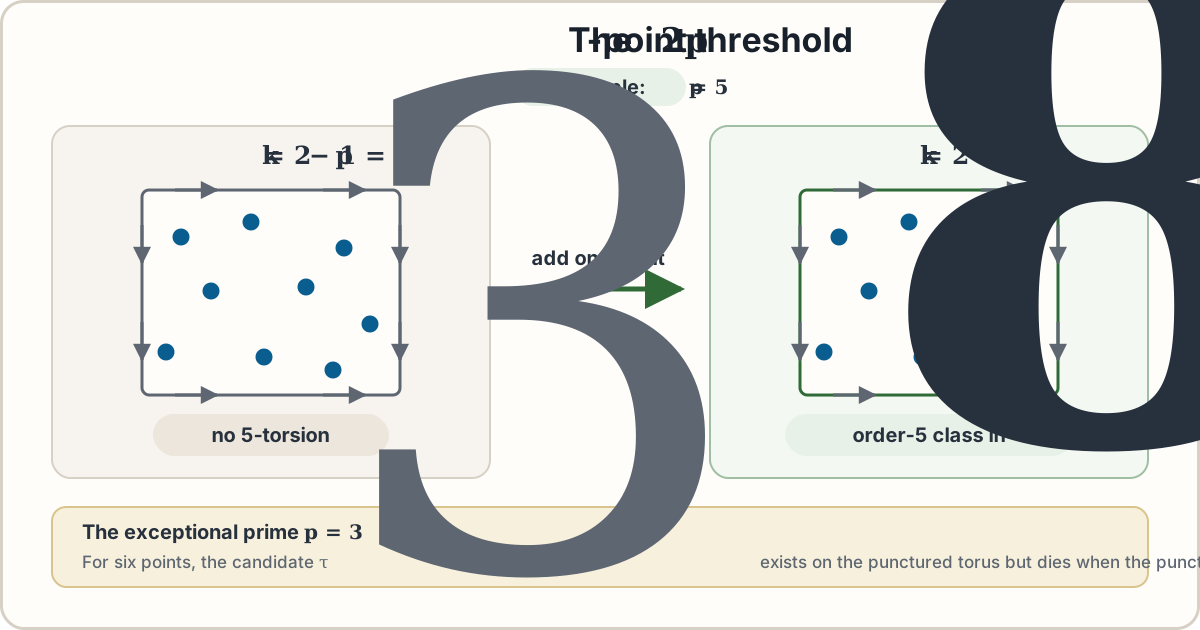
At the critical weight , the candidate survives for ; the smallest odd prime is exceptional.
Ordered points, unordered points, and braids
For a space , the ordered configuration space of points is
The coordinates label the points: exchanging and changes the configuration. If the particles are indistinguishable, we instead divide by the symmetric group:
The same space is also commonly denoted .
This ordered/unordered distinction is the same distinction as the one between pure braids and ordinary braids. For most surfaces, including the torus , these configuration spaces are aspherical. Their homology is therefore also the group homology of the corresponding surface braid groups. In the torus case, the unordered fundamental group is sometimes called the elliptic braid group.
Our paper is about the unordered spaces . Passing to the quotient by is precisely the sort of operation that can create intricate torsion phenomena.
What does torsion measure?
A homology class has order if it is nonzero but . Geometrically, one can think of a cycle that does not bound, although copies of it do. Such a class is invisible over the rational numbers, where division by is allowed. This is why knowing all rational Betti numbers—or even the rational cohomology ring—does not settle the integral problem.
Working modulo can reveal the shadow of integral -torsion, but reconstructing the integral answer requires keeping track of Bocksteins and universal-coefficient phenomena. In the punctured-torus calculation we use, two extra mod- classes in adjacent degrees correspond to a single integral order- class. Counting mod- generators alone would therefore give the wrong picture.
The rational homology of torus configuration spaces is well understood, and low-weight integral calculations by Napolitano found only -primary torsion for up to six points. More recently, Chen and Zhang proved that has no -torsion when , and predicted that the first possible weight should be . Here “weight” is just the number of points.
We prove the following.
The result. For every odd prime , the integral homology of has no -torsion when . If , then
contains a nonzero class of order . For , the analogous punctured-torus class maps to zero in .
This is not a complete calculation of . We exhibit a class, but do not determine the whole -primary subgroup in the critical degree.
The punctured torus knows the candidate
The key input is the recent calculation by Bianchi and Stavrou for surfaces with one boundary component. Let
be a once-punctured torus. Their results imply that, up to weight , its configuration spaces have exactly one -torsion group:
Call a generator of this group . The natural inclusion fills the missing point and induces
The question is now very concrete: is zero?
There is no formal reason for a class to survive. A cycle that does not bound while configurations are forbidden to pass through may become a boundary once that point is available again. The case shows that this can actually happen.
Below the threshold: mark one point and translate it away
The proof that no -torsion occurs for uses a pleasant feature of the torus: it is a topological group.
Let be the space of unordered -point configurations together with one chosen point of the configuration. Forgetting the choice gives a -sheeted covering
Translate the chosen point to the identity of the torus. What remains is an unordered configuration of points avoiding the identity. This gives a homeomorphism
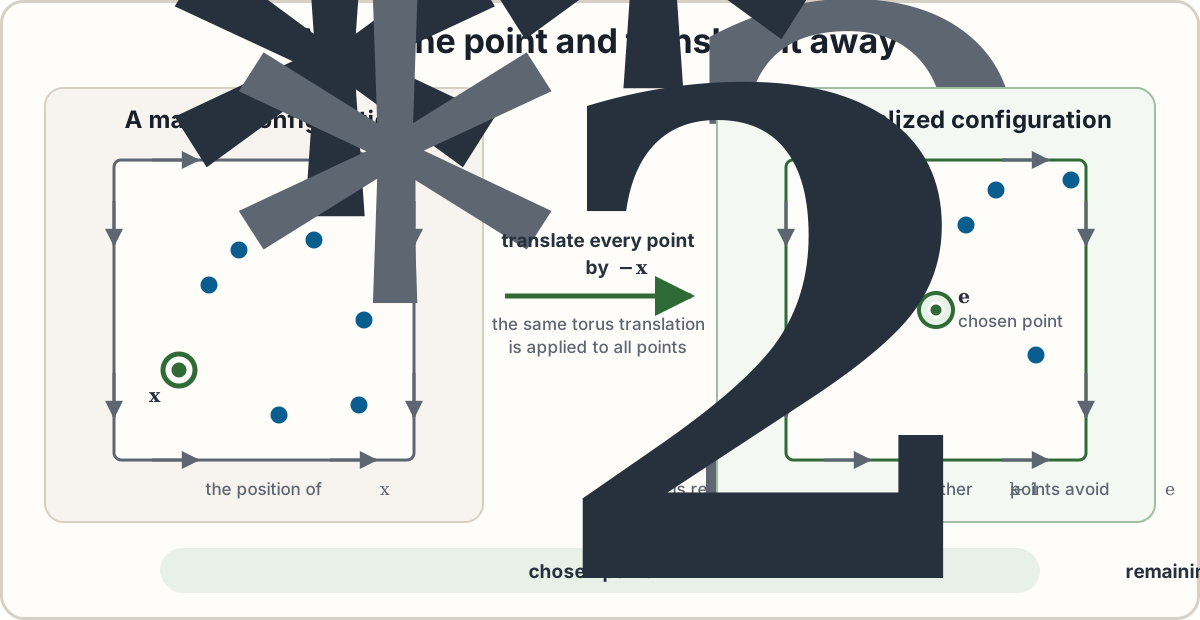
The position of the marked point gives the factor; after translation, the other points form a configuration in .
Now localize at . If , the transfer of the covering splits the map on homology, so the -local homology of is a direct summand of that of the marked-point space. For , the integer is not divisible by , while . The Bianchi–Stavrou calculation says that the punctured factor has no -torsion there. Thus the marked-point space has -torsion-free homology, and so does its direct summand .
Together with the previously known range , this proves the nonexistence statement all the way up to . At , however, the degree of the covering is divisible by , and the transfer no longer splits.
At the threshold: can filling the puncture kill the class?
To answer this, we use the Gysin exact sequence for the inclusion
The relevant part, with coefficients localized at , is
Exactness says that dies after filling precisely when it lies in the image of . We therefore need to distinguish one particular class in the target from every possible class coming from the source.
The distinction comes from symmetry. The mapping class group of the punctured torus acts on the sequence, and is equivariant. After reduction modulo , the line spanned by the reduction of is a trivial representation of a suitable finite quotient of this mapping class group. In other words, the reduced class is fixed by all the relevant symmetries.
We then compute the representation carried by the source. We filter the Bianchi–Stavrou cellular model. A comparison with a small Chevalley–Eilenberg complex shows that the associated graded of the source representation takes the form
where is the standard representation of and denotes divided powers. Its composition factors are
Passing to the associated graded does not change the multiset of composition factors, so this list also controls the original source representation.
For , none of these is the trivial representation . Therefore no quotient of the source—and in particular no image of an equivariant map from it—can contain the fixed line spanned by the reduction of . It follows that is not hit by , so is a nonzero order- class on the closed torus.
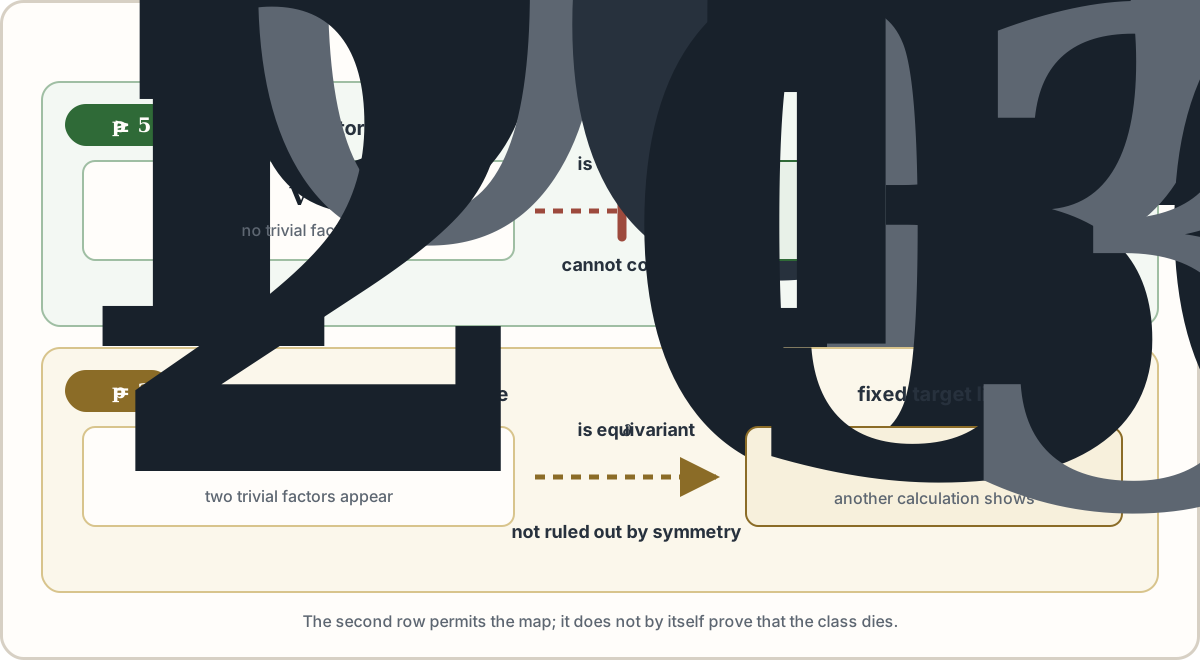
For , the absence of in the source prevents from being hit. For , symmetry alone is inconclusive.
This is the main argument of the paper: exactness reduces the question to the image of the Gysin boundary, and the representation calculation shows that is not in that image.
Why is different?
Substituting into the same calculation gives
Two trivial composition factors have appeared in the source. The symmetry argument no longer separates from the image of . This does not by itself prove that the class dies; it only removes our obstruction to its death.
Here Napolitano’s explicit low-weight calculation settles the question. It gives
The universal coefficient theorem then implies that has no -torsion. Since has order dividing , it must be zero. Thus the puncture-filling map really kills the candidate class at the smallest odd prime.
Two further vanishing results
The critical class lies in degree , but we can also rule out -torsion in degrees and at weight . This part of the proof uses a different tool: Napolitano’s Borel–Moore cellular decomposition of the closed torus configuration space.
Poincaré duality and the universal coefficient theorem translate torsion in high ordinary homological degrees into torsion near the bottom of the Borel–Moore complex. Separating cells according to whether a fixed “north pole” of the torus is occupied gives a short exact sequence relating the closed and punctured cellular complexes. In the bottom relevant degree, the punctured homology is generated by particularly simple cells, and the connecting map on these generators has coefficients or . Because is odd, is invertible after localization at . The resulting cokernel is a free module of rank , rather than a torsion module.
This also indicates one reason why we consistently assume that is odd. At the prime , the same coefficients are no longer units, so this argument does not apply; our theorem makes no claim about the first occurrence of -primary torsion.
What remains open?
The result identifies the exact first weight for -torsion when , but it leaves several natural questions.
- We do not know whether contains additional -torsion beyond the class we construct.
- We do not know whether there is -torsion in degree at weight . We do prove that degrees and contain none, using Napolitano’s Borel–Moore cellular decomposition.
- For , there is no -torsion through weight six. Where does the first surviving -torsion occur, if it occurs at all?
- At larger weights, the marked-point transfer stops applying whenever the covering degree is divisible by , while new trivial representation-theoretic factors may enter the source of the Gysin boundary.
- In higher genus, the same general strategy should involve symplectic representations together with a nontrivial Johnson layer. The genus-one calculation is the first case, not a template that can simply be copied unchanged.